
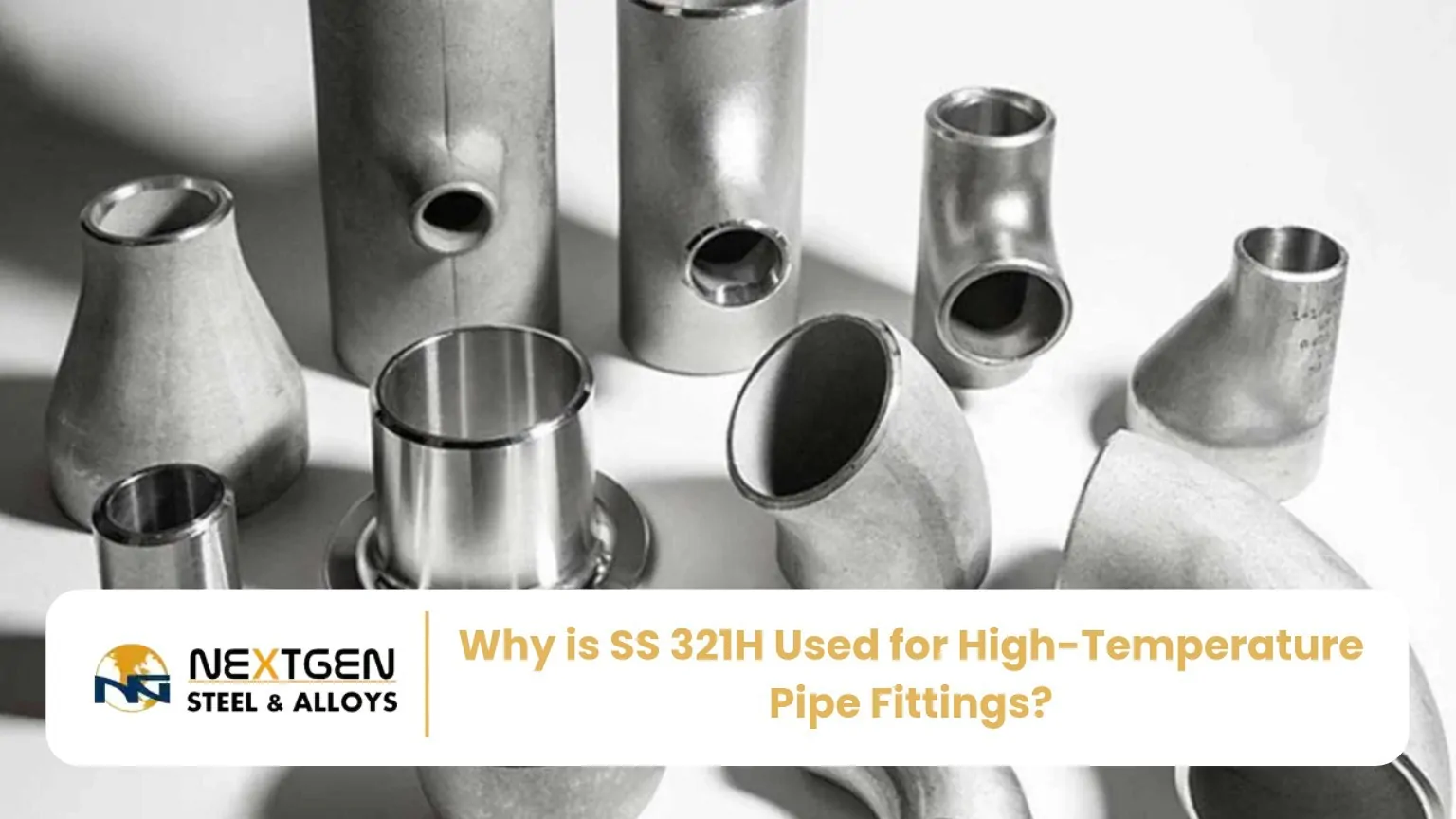
SS 321H serves high-temperature pipe fittings because its controlled carbon and titanium stabilisation keep mechanical strength, creep resistance, and oxidation resistance intact where standard grades fail early. Hot piping systems load fittings with sustained heat, pressure, and stress rupture over long run times, so the alloy has to stay dimensionally stable for years rather than months. Nextgen Steel & Alloys supplies SS 321H pipe fittings alongside stainless, carbon, mild, alloy, and nickel-based grades for this kind of service.
What Makes SS 321H Different From Standard SS 321?
SS 321H is the high-carbon version of 321. Standard 321 caps carbon at 0.08 %, while 321H holds it in a tighter 0.04 to 0.10 % band. That extra carbon earns its place at temperature, raising creep strength and stress-rupture life once service passes roughly 538°C (1000°F), where codes start specifying the H grade. Titanium sits in both chemistries, binding carbon so it can’t pull chromium out of the composition. The real separation shows under heat: how long the fitting keeps its shape under combined load, not its room-temperature corrosion behaviour.
Why Does SS 321H Perform Well at High Temperatures?
Improved Creep Resistance
SS 321H resists creep, the slow deformation that fittings suffer under constant stress at high heat, because titanium and carbon carbides pin grain boundaries. Strong creep resistance keeps elbows in use for years.
Better Stress-Rupture Performance
Stress rupture ends a fitting’s service when sustained load finally cracks it at temperature. The controlled chemistry of 321H extends time to rupture, which matters where piping stays hot and pressurised without pause.
Strength Retention
Mechanical strength falls quickly in most steels as temperature climbs. SS 321H retains a usable share deep into elevated service, so fittings carry rated pressure without thinning or sagging.
Resistance to Oxidation
Chromium at 17 to 19 % builds an oxide skin that shields SS 321H from scaling. Nickel at 9 to 12 % holds the austenite stable up to roughly 870°C in air and flue gas.
How Does Titanium Stabilisation Help SS 321H Fittings?
Titanium binds with carbon to form stable titanium carbides before chromium can react. That reaction keeps chromium dissolved in the composition instead of precipitating as chromium carbides along grain boundaries in the 425 to 815°C sensitisation range. Where fittings get welded or held hot, that protection is what preserves intergranular corrosion resistance over a long service life. Without it, heat-affected zones would sensitise, and the welds in a piping run would corrode first.
Where Are SS 321H Pipe Fittings Commonly Used?
SS 321H fittings turn up wherever piping runs hot for long stretches: refineries, power plants, furnaces, exhaust ducting, and chemical units all depend on them.
Petrochemical and Refinery Piping
Refinery and petrochemical units run reformers, crackers, and transfer lines at high heat, where SS 321H pipe fittings join sections that must resist creep and sulfidation through continuous process cycles.
Power Generation Systems
Power plants route superheated steam through headers, superheaters, and reheat piping that sit well above 538°C.
Furnace and Heat-Treatment Equipment
Furnace builds use elbows, tees, and reducers across radiant sections and recuperator piping.
Aerospace and Exhaust Systems
Exhaust manifolds, ducting, and engine-bay piping in aerospace demand high-temperature strength with low weight gain from scaling.
Chemical Processing Equipment
Chemical plants pair high temperature with aggressive media across reactors, jacketed lines, and heat-transfer loops.
Which Types of SS 321H Fittings Are Used in High-Temperature Piping?
SS 321H Elbows
Elbows redirect flow at 45 or 90 degrees while carrying the same heat and pressure as the pipe. Their curved wall concentrates stress, so creep resistance stops the bend from thinning over time.
SS 321H Tees
Tees split a line into a branch, forming a junction that experiences uneven thermal expansion. SS 321H keeps that joint stable as a branch and runs hot and cold, preventing cracks at the intersection.
SS 321H Reducers
Reducers connect pipes of different diameters and manage the velocity change between them. The concentric or eccentric body must hold pressure at heat, so strength retention guards the step-down in bore.
SS 321H Caps and Stub Ends
Caps seal the end of a line; stub ends pair with lap-joint flanges for dismantling. Both close or connect hot sections, so the sealing face resists creep and oxidation under long exposure.
What Should You Consider When Selecting SS 321H Fittings?
Choosing the right fit isn’t just about the grade. The service conditions and the code governing the system decide the wall thickness, dimensions, and testing you actually need. Run through the points below before you place an order for SS 321H fittings.
- Operating temperature, peak and continuous
- Pressure rating at service temperature
- Pipe size, bore and schedule
- Wall thickness and corrosion allowance
- Fitting dimensions and end preparation
- Welding procedure and filler metal
- Corrosive environment: chlorides, sulfidation
- Material specification confirming 321H over 321
- Required testing: PMI, hydrotest, NDT
- Application-specific standards for your sector
SS 321H Fittings vs Conventional Stainless Steel Fittings
Conventional 304 or 316 fittings serve ambient and moderate-heat duties at lower cost. However, they lack the controlled carbon and titanium stabilisation that give SS 321H its superior creep strength and oxidation resistance under prolonged heat. Below 538°C, standard grades are usually sufficient, but sustained high-temperature service requires the stabilised grade to avoid creep, scaling, or sensitisation.
Conclusion
SS 321H fittings fit demanding high-temperature piping because controlled carbon, titanium stabilisation, creep resistance, stress-rupture strength, and oxidation resistance work together under sustained heat. None of that removes the need to check operating temperature, pressure, dimensions, fabrication, and the governing standard before you buy. Match the fitting to the service, and it’ll hold for the long haul. Contact Nextgen Steel & Alloys for SS 321H fittings matched to your temperature, pressure, and code requirements.