
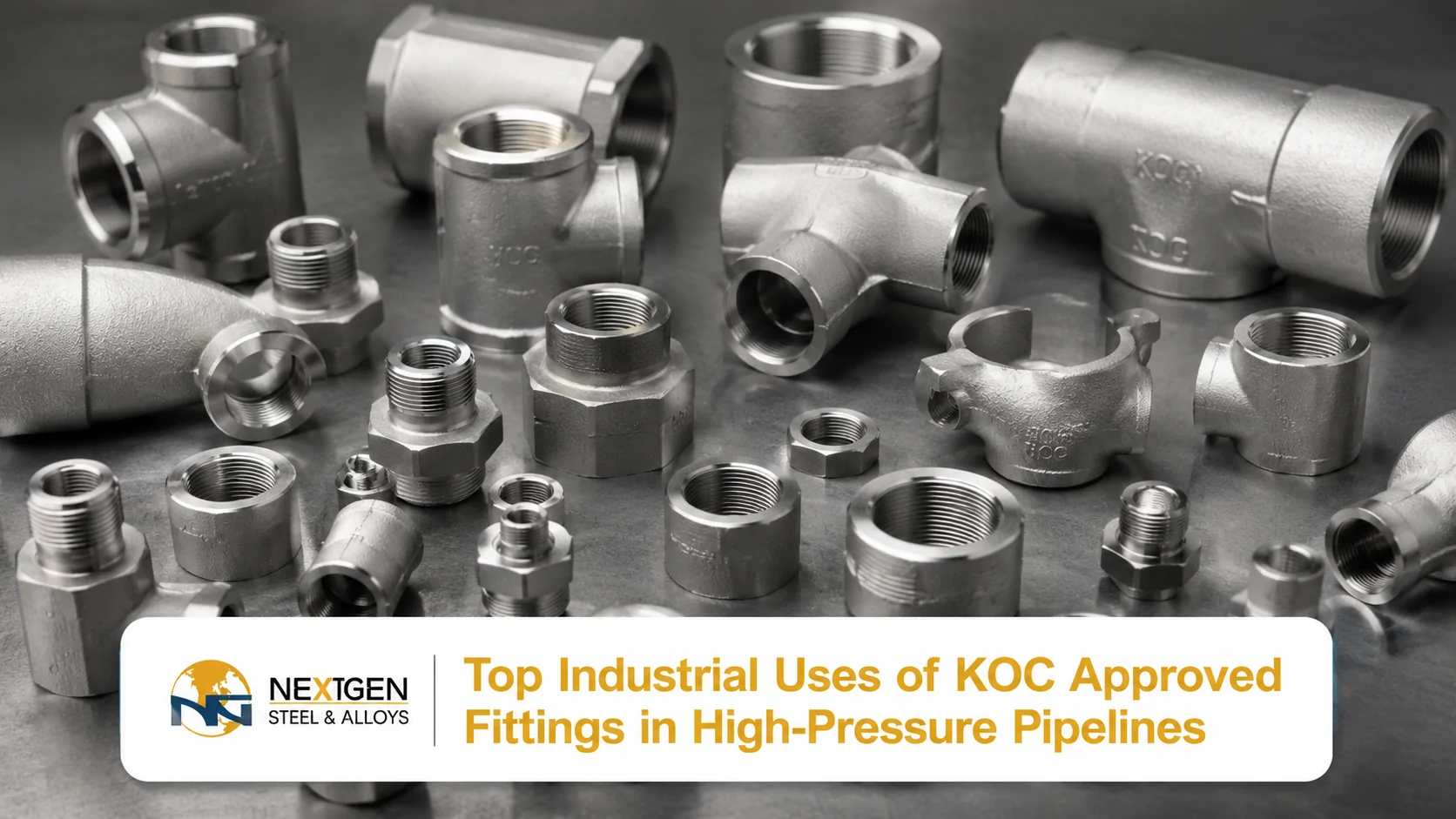
KOC Approved Fittings are extremely vital to prevent catastrophic leaks, expensive downtime and structural failures in high pressure industrial pipes. These components are qualified to the strict safety and performance criteria of the Kuwait Oil Company, and are designed to withstand extreme pressures and highly corrosive media. The use of these fittings guarantees operational efficiency and durability of the system in the long run in the most difficult environments of the oil and gas sector.
What Are KOC Approved Fittings?
KOC Approved Fittings are pipe fittings that have been tested, examined and approved to meet the Kuwait Oil Company specifications for use in operations and projects. Fitment clearance at KOC is stringent considering the size and requirements of its operations, which include production, processing and export of crude oil.
The adherence to these criteria and global industry standards gives engineers and operators the confidence a fitting will perform as intended under the pressures, temperatures and media it is likely to encounter. KOC Approved Fittings are available in different materials, designs and pressure classes to satisfy the requirements of high pressure pipe systems in upstream, midstream and downstream activities.
Key Features of KOC Approved Fittings
A few characteristics define what makes a fitting suitable for KOC approval. High-pressure resistance is fundamental, since these fittings are often deployed in systems operating at pressures that would push lesser components past their limits. Corrosion and temperature resistance matter just as much, given the harsh media and environmental conditions common in oil and gas operations. Dimensional accuracy and structural reliability ensure that fittings integrate seamlessly into piping systems without introducing weak points. And compatibility with critical industrial pipeline systems means these fittings need to work reliably alongside other certified components, forming a system that’s only as strong as its weakest link.
Why KOC Approved Fittings Are Essential for High-Pressure Pipelines
High pressure pipelines have very little room for error, and the fittings used throughout these systems have a direct role in ensuring that connections stay leak-free and secure during years of operation. A failure, even a little one, at a fitting can increase rapidly in a high-pressure environment. So operational safety depends greatly on getting this element of the system right.
Beyond safety, the long-term reliability of a pipeline system depends on every component performing consistently, and fittings are no exception. In harsh industrial settings, and especially in offshore environments where access for repairs is limited and expensive, the advantages of using properly certified fittings become even more apparent.
Performance Benefits in Critical Operations
KOC Approved Fittings are designed to withstand the mechanical stress and vibration seen in industrial pipeline services. This resistance makes the machine’s components durable in severe operating settings where pressure and temperature changes and 24/7 operation would kill lower-quality components. Major operational and financial impacts due to downtime and pipeline failures.
Top Industrial Uses of KOC Approved Fittings in High-Pressure Pipelines
KOC Approved Fittings find their way into a wide range of industrial applications, each with its own demands and challenges.
Oil and Gas Transmission Pipelines
These fittings transport high-pressure crude oil, natural gas and refined goods through upstream, midstream and downstream pipelines. Due to the volume and pressure, transmission systems have to be reliable; any breakdown along the line may damage the whole network.
Petrochemical Processing Plants
Pipework in petrochemical facilities is subjected to severe chemicals and high-temperature process media on a daily basis. KOC Approved Fittings are designed for use in these environments where chemical exposure and heat stress rapidly degrade lower quality fittings, for safe and efficient fluid transfer systems.
Offshore and Marine Pipeline Systems
Offshore platforms and subsea activities are the most difficult settings for pipe systems, because of continuous exposure to seawater and marine mechanical requirements. In regions where access for maintenance is restricted, KOC Approved Fittings shall be able to resist seawater corrosion and maintain structural integrity.
Refinery and Power Generation Facilities
Refineries and power generation plants rely heavily on steam, condensate, and high-pressure utility lines that run continuously as part of core operations. KOC Approved Fittings help maintain operational reliability in these critical infrastructure systems, where unplanned downtime can have cascading effects across an entire facility.
Water Injection and Desalination Systems
Water Transport and Treatment Applications KOC Approved Fittings are the perfect fit where high pressure and corrosion meet. These parts can easily handle high water chemistry and harsh pressure requirements. They are the most reliable for heavy duty industrial systems. They are chosen to maintain basic water injection methods in oil recovery and existing desalination facilities.
Types of KOC Approved Fittings Commonly Used in Industrial Pipelines
Different types of fitting require a KOC clearance and all have a specific role in high pressure pipe systems.
Curves and Elbows
Elbows and bends are used in plumbing systems to modify the direction of flow so that pipelines can run around obstacles, change elevation or change the direction of flow as required in complex layouts.
Cross Fittings and Tees
Tees and cross fittings are used to branch or distribute the flow in a pipeline, allowing one line to split off in numerous directions or to combine flows from several sources into a system.
Reducers.
Reducers are used to move from one pipe size to another and help manage the pressure and flow characteristics when a pipeline changes from a larger diameter to a smaller diameter or vice versa.
Caps and Couplings
Couplings and caps are used to seal pipe connections and protect pipe ends and are critical to maintaining system integrity at junctions and termination sites in critical pipeline systems.
Material Selection Considerations for KOC Approved Fittings
Choosing the right material for KOC Approved Fittings is just as important as the fittings themselves meeting approval standards, since the wrong material choice can undermine performance even in a properly certified fitting.
Stainless Steel and Duplex Steel Fittings
Stainless steel and duplex steel fittings offer strong corrosion resistance combined with solid mechanical strength, making them suitable for a wide range of pipeline applications where both durability and resistance to aggressive media are priorities.
Nickel Alloy and Carbon Steel Fittings
Nickel alloy and carbon steel fittings are often selected for their suitability in high-temperature and high-pressure applications, where their specific material properties provide advantages that standard stainless steel grades may not match.
Compatibility With Process Media
In addition to the basic material qualities, the compatibility with the process media a fitting will be in contact with during its life is also an important aspect to avoid corrosion, erosion and material degradation. Even a very well made fitting can fail if the materials used are not compatible with the fluids or gasses that will be passing through it.
Key Factors Affecting the Performance of KOC Approved Fittings
A number of operational and environmental factors influence how well KOC Approved Fittings perform over their service life.
Pressure and Temperature Conditions
Matching fittings with the actual operating parameters of a system is fundamental to long-term performance. Fittings selected for conditions beyond their rated capabilities, even by a small margin, can experience accelerated wear or unexpected failures.
Installation Quality
Good welding, alignment and inspection techniques during installation greatly influence the performance of fittings once a system is operating. It doesn’t matter how good the fitting is, if it’s installed in a way that causes stress spots or misalignment to the system, it can perform less.
Maintenance and Inspection Procedures
Preventive maintenance and regular inspection help catch potential issues before they become failures, contributing significantly to overall pipeline durability and safety over the system’s operational lifespan.
Advantages of Using KOC Approved Fittings in Industrial Projects
Specifying KOC Approved Fittings offers many benefits for project performance. Due to systems meeting high industry and project standards, engineers and operators know they are meeting rigorous operational criteria. Designed for real-world situations to improve operating safety and reduce maintenance costs. Long service life in tough industrial conditions, no replacements and downtime. High-pressure pipeline systems provide constant performance, and there are less surprises and more predictable operations.
Conclusion
KOC Approved Fittings play a foundational role in keeping high-pressure pipeline operations safe, efficient, and reliable. Their value extends across oil and gas, petrochemical, offshore, and power generation industries, where the stakes of fitting failure are simply too high to leave to chance.
Proper material selection, careful installation and continuous compliance with industry standards are all key to the long-term reliability that high-pressure pipeline systems demand if the benefits of these fittings are to be maximized. One of the best methods to construct systems that stand the test of time for applications where safety and performance cannot be sacrificed is to specify KOC Approved Fittings.