
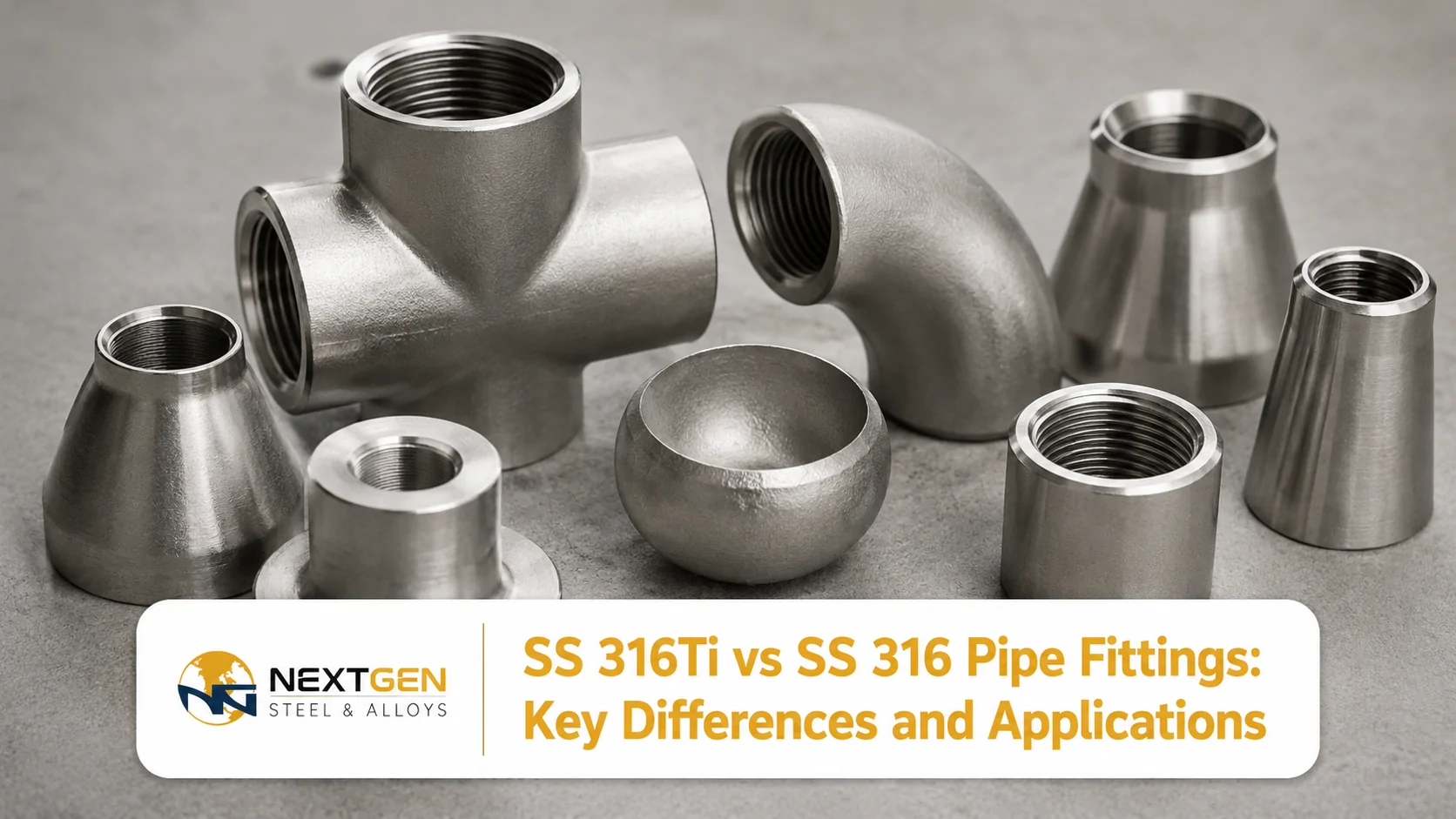
Industrial piping networks require robust materials capable of withstanding severe operational stresses. Selecting the correct alloy grade dictates whether a pipeline operates flawlessly for decades or suffers a catastrophic failure. Among the diverse materials utilized across critical processing sectors, standard SS 316 and specialized SS 316Ti pipe fittings frequently drive engineering discussions. On paper, these two alloys appear almost identical, yet their field performance diverges sharply under heavy thermal and chemical loads.
Understanding these boundaries is essential for managing high-temperature and highly aggressive fluid environments. Specifying the wrong material inevitably manifests as localized corrosion, stress cracking, or structural failures at joint connections, which are exceptionally expensive to repair once a plant is operational. This comprehensive guide outlines the technical variations, performance metrics, and application spaces that separate these two essential austenitic stainless steel options.
Understanding SS 316Ti and SS 316 Pipe Fittings
Austenitic stainless steel pipe fitting grades like SS 316, SS 316Ti are chosen for heavy industrial applications because of their high tensile strength, flexibility and corrosion resistance. Austenitic grades have a face-centered cubic crystal structure, therefore mechanical properties are retained at extreme temperatures, minimizing brittleness during unanticipated environmental changes.
Both alloys begin with a carefully balanced combination of chromium, nickel and molybdenum. Molybdenum reduces localized pitting and crevice attack in chloride-rich environments. Nickel stabilizes the austenitic crystalline matrix and chromium suppresses oxidation. The unique feature of SS 316Ti is the deliberate addition of titanium. This single alloying element affects the microscopic behavior of the material under severe, prolonged process heat.
What Are SS 316 Pipe Fittings?
SS 316 pipe fittings are standard molybdenum-bearing components. Containing 2% to 3% molybdenum, they resist chloride pitting, marine settings, and industrial acids better than SS 304, serving as a reliable benchmark.
SS 316 fittings are reliable for moderate temperatures and general chemical exposure in typical operating settings. They offer poor mechanical performance, are easy to cut, thread and weld, and provide an attractive trade-off between the initial cost of the material and consistent performance in the field. SS 316 is the default standard for the great majority of processing plants unless some extreme circumstances need a more resistant alloy.
What Are SS 316Ti Pipe Fittings?
SS 316Ti pipe fittings are titanium-stabilized variations of SS 316. The added titanium serves as a stabilizing agent, preventing microstructural shifts and chemical breakdown during long-term exposure to extreme heat.
The primary engineering advantage of SS 316Ti fittings is their exceptional resistance to intergranular corrosion. When standard stainless steel is heated, it undergoes a process called sensitization, which compromises its structural integrity. SS 316Ti is specifically engineered to resist this vulnerability. For heavy industrial plants operating continuous thermal cycles or maintaining sustained high temperatures, SS 316Ti pipe fittings offer a layer of long-term structural security that standard SS 316 simply cannot achieve.
Key Differences Between SS 316Ti and SS 316 Pipe Fittings
While these two metals look identical on a warehouse shelf, a direct comparison of both stainless steel grades based on industrial performance highlights several critical differences under severe operational stress.
Chemical Composition Differences
The main difference is the inclusion of titanium to SS 316Ti which captures carbon in accordance with the following calculation Ti >= 5 x (%C + %N) . Other element levels are the same. Therefore, the room temperature corrosion profiles are essentially indistinguishable.
High Temperature Resistance
Standard SS 316 is susceptible to intergranular cracking due to chromium carbide precipitation in the temperature range of 425°C to 815°C. SS 316Ti ties up carbon with titanium first to leave chromium evenly dispersed for full high temperature corrosion resistance.
Comparison of Corrosion Resistance
Both alloys are similarly resistant to ambient temperature chemicals. However, with high process heat or welding, regular SS 316 is prone to quick local sensitization at the joints while SS 316Ti exhibits remarkable structural homogeneity.
Strength and Durability
The room-temperature strengths are the same but SS 316Ti has a far greater resilience in the case of long-term pressure at high temperatures. The tool’s strong titanium carbide matrix provides a dispersion strengthening effect that is efficient against deformation under high temperature loads.
Weldability and Fabrication
Standard SS 316 is easier to manufacture and produces less tool wear in ordinary fabrication. However SS 316Ti is an excellent heavy field welding and does not require post heat treatment to reinstate the corrosion resistance.
Applications of SS 316 Pipe Fittings
Thanks to its balanced properties, SS 316 remains the standard choice for general industrial applications where moderate temperatures and reliable corrosion control are required.
Chemical Processing Systems
SS 316 fittings offer a reliable solution for many process fluids in mid-temperature chemical systems with good protection against a variety of corrosive compounds.
Food & Beverage Industry
SS 316 is used to satisfy strong sanitary requirements, resists attack from acids present in organic foods and from thorough chemical washdowns that neither degrade nor contaminate the product.
Pharmaceutical Equipment
Smooth, easily cleaned SS 316 surfaces that do not contaminate the product, perfect for high purity pharmaceutical transfer lines.
Water Treatment and Pipe Systems
SS 316 components can be continuously subjected to treated water, purification chemicals and external conditions throughout extended operational cycles.
Applications of SS 316Ti Pipe Fittings
Where process settings are outside the thermal limits of ordinary stainless steels, SS 316Ti is used to provide long term stability and safety.
Heat Exchangers and Boilers
SS 316Ti handles extreme thermal cycling safely, resisting the high-heat carbide precipitation that degrades standard grade 316 fittings.
Petrochemical and Refinery Systems
Combining high heat with aggressive hydrocarbon exposure, refineries use SS 316Ti to provide long-term structural security at joints.
Marine and Offshore Applications
SS 316Ti withstands both hot process environments and harsh offshore saltwater, surviving tough, high-maintenance marine installations.
High-Temperature Industrial Piping
Operating continuously at elevated temperatures, SS 316Ti prevents the hidden, localized grain corrosion that risks unexpected pipeline failures.
How to Choose Between SS 316Ti and SS 316 Pipe Fittings
Choosing between these grades requires balancing upfront costs against operating conditions. Standard SS 316 is ideal for moderate temperatures and general chemical handling. However, if your system involves extensive welding, frequent thermal cycling, or continuous heat above 425°C, upgrading to titanium-stabilized SS 316Ti is essential. This investment prevents sensitization and localized corrosion, ensuring long-term operational safety.
Operating Temperature Requirements
For systems running within sensitization ranges (425°C–815°C) or experiencing continuous thermal cycling, SS 316Ti prevents long-term grain boundary corrosion.
Corrosive Environment Exposure
Standard SS 316 works perfectly for moderate-temperature chemical environments, but combining aggressive chemical media with high heat requires SS 316Ti.
Welding and Fabrication Needs
Heavy field welding on lines facing high service temperatures benefits from SS 316Ti’s heat-zone stability, skipping costly post-weld heat treatments.
Budget and Long-Term Maintenance Considerations
While SS 316Ti carries higher upfront costs, it prevents expensive downtime, repairs, and premature failures in severe high-temperature operations.
Benefits of Using SS 316Ti Pipe Fittings in Industrial Systems
The advantages of SS 316Ti are particularly evident in a harsh industrial setting. Improved resistance to sensitization and intergranular corrosion implies fewer surprises during inspections and unscheduled downtime. This will help systems continue to run reliably under prolonged heat stress and perform better in high temperature conditions. This translates into longer life in the demanding environment of an industry over the years, with lower maintenance and replacement all adding up to significant savings throughout the lifecycle of a piping system.
Common Mistakes to Avoid When Selecting Stainless Steel Pipe Fittings
A frequent mistake is assuming that because standard SS 316 has a high melting point, it can safely operate at 600°C without issue. While the metal will not melt, it will undergo rapid sensitization, leading to sudden, unexpected corrosion failures. Engineers also sometimes overlook SS 316L; while low-carbon 316L avoids carbide precipitation during welding, it loses mechanical strength at high temperatures, whereas SS 316Ti maintains both strength and corrosion protection. Selecting fittings based purely on initial cost rather than operational performance is equally costly, as the cheaper option upfront can easily turn into the more expensive option over the life of the system.
Conclusion
SS 316 and SS 316Ti share the same base, however the titanium stabilization makes the 316Ti function better at high temperature. The standard SS 316 is an inexpensive, reliable solution for general corrosion resistance at moderate temperatures. But in harsh industrial applications with consistent thermal cycling and high temperatures SS 316Ti provides a longer service life, less maintenance hassles and structural stability.