
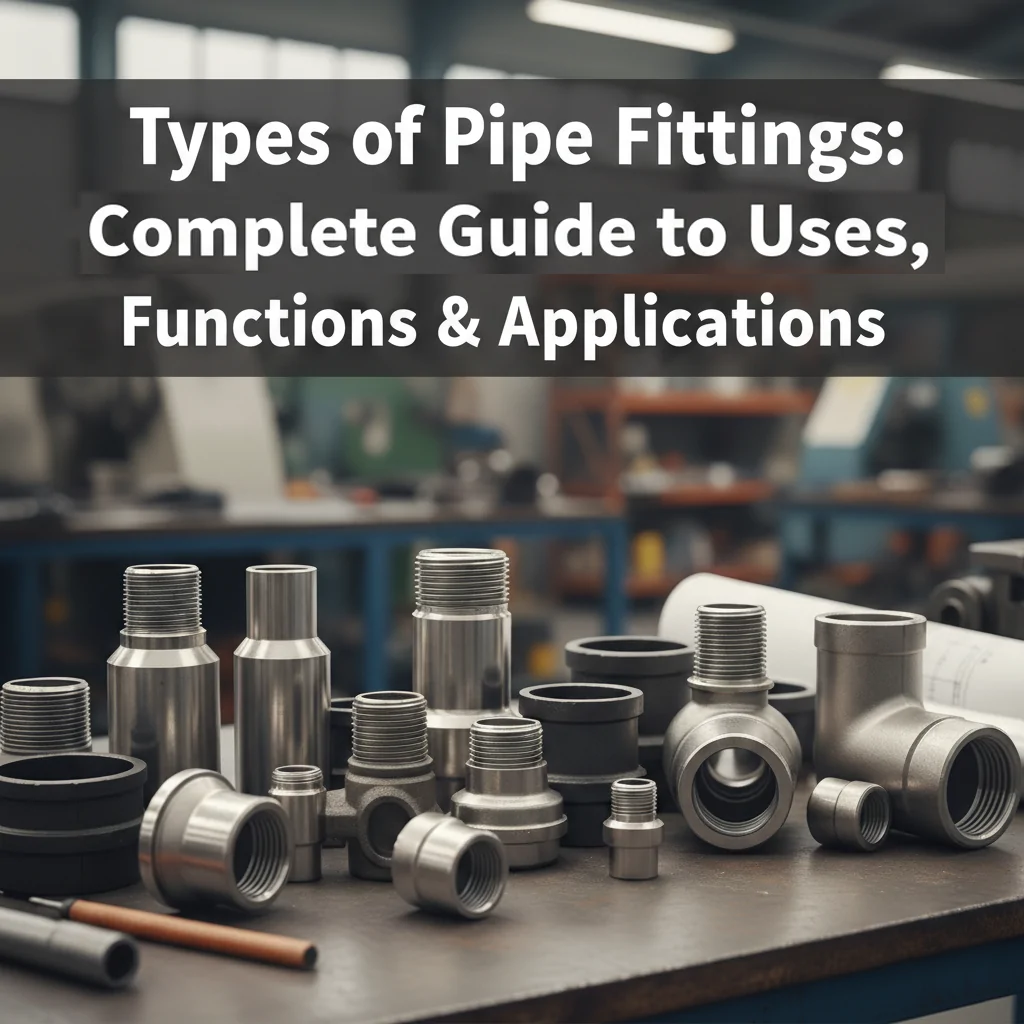
What Are Pipe Fittings?
In any piping system, fittings are important. They join pipes, change the flow direction, and control pressure. Without them, you can’t build a strong and safe pipeline. If you work in construction, plumbing, or industrial projects, knowing the types of pipe fittings will help you pick the right ones for the job. Let’s look at them in a clear and easy way.
Importance of Pipe Fittings in Piping Systems
Pipe fittings allow pipelines to adapt to spatial constraints, change flow direction, and accommodate maintenance. Proper selection and installation of fittings prevent leaks, reduce wear, and enhance system reliability, especially in industrial and high-pressure applications.
Common Types of Pipe Fittings
1. Elbow Pipe Fittings
Elbows change the direction of fluid flow, typically by 45° or 90°. They are widely used in plumbing, oil, gas, and industrial pipelines.
2. Tee Pipe Fittings
Tees divide or combine flow in a piping system. Available as equal or reducing types, they are essential for branching pipelines.
3. Reducer Pipe Fittings
Reducers connect pipes of different diameters while maintaining smooth flow. Concentric reducers align centrally, whereas eccentric reducers align at the bottom.
4. Coupling Pipe Fittings
Couplings join two pipes of the same or different diameters. They can be permanent or removable, depending on system requirements.
5. Union Pipe Fittings
Unions allow quick disconnection and reconnection of pipes, making them ideal for systems requiring frequent maintenance.
6. Cross Pipe Fittings
Cross fittings connect four pipes, facilitating multiple flow directions. They are used in specialized industrial layouts.
7. Cap and Plug Fittings
Caps seal the end of a pipe externally, while plugs fit inside to stop flow. Both prevent leakage from unused pipe ends.
Pipe Fittings Based on Connection Type
1. Threaded Pipe Fittings
Threaded fittings use screw threads to join pipes. They are common in low-pressure systems and easy to install.
2. Socket Weld Pipe Fittings
Socket weld fittings are welded at the socket joint, offering strong, leak-proof connections for small-diameter pipes.
3. Butt Weld Pipe Fittings
Butt weld fittings are welded end-to-end, providing high-strength joints suitable for high-pressure and high-temperature systems.
4. Flanged Pipe Fittings
Flanged fittings connect pipes with bolts, allowing easy assembly, disassembly, and maintenance.
5. Compression Pipe Fittings
Compression fittings use a compressive force to seal pipes, often used in plumbing and instrumentation systems.
Materials Used for Pipe Fittings
Pipe fittings are made from metals like carbon steel, stainless steel, and nickel alloys, as well as plastics such as PVC and CPVC. Material choice depends on pressure, temperature, corrosion resistance, and application.
Industrial Applications of Pipe Fittings
Fittings are used across industries including oil and gas, chemical processing, water treatment, HVAC, and construction. They ensure smooth operation, safety, and system durability.
How to Choose the Right Pipe Fittings
Consider pipe size, material compatibility, pressure rating, temperature, and connection type. Selecting the correct fitting enhances efficiency, minimizes maintenance, and ensures system safety.
Conclusion: Selecting the Right Fittings for Reliable Piping Systems
Proper selection and installation of pipe fittings are critical for the reliability, safety, and efficiency of any piping system. Understanding types, materials, and connection methods ensures optimal performance in both industrial and commercial applications.
FAQs
Are welded pipe fittings better than threaded fittings?
Welded fittings provide stronger, leak-proof joints for high-pressure and high-temperature applications, while threaded fittings are easier to install for low-pressure systems.
Where are elbow and tee pipe fittings commonly used?
Elbows and tees are widely used in plumbing, oil, gas, and industrial pipelines to redirect flow and branch pipelines.
What standards apply to industrial pipe fittings?
Standards like ASME, ASTM, and ISO govern dimensions, pressure ratings, and material specifications for industrial pipe fittings.
Why are proper pipe fittings important in piping systems?
They ensure leak-free connections, proper flow, maintenance accessibility, and overall system safety.
How do I choose the right pipe fitting for my application?
Consider system pressure, temperature, material compatibility, connection type, and maintenance requirements to select the optimal fitting.